Mastering the Competition: A Guide to Porter’s 5 Forces
If you’ve ever wondered why the airline industry struggles to turn a profit while soft drink companies seem to print money, you aren’t just looking at bad luck—you’re looking at industry structure.
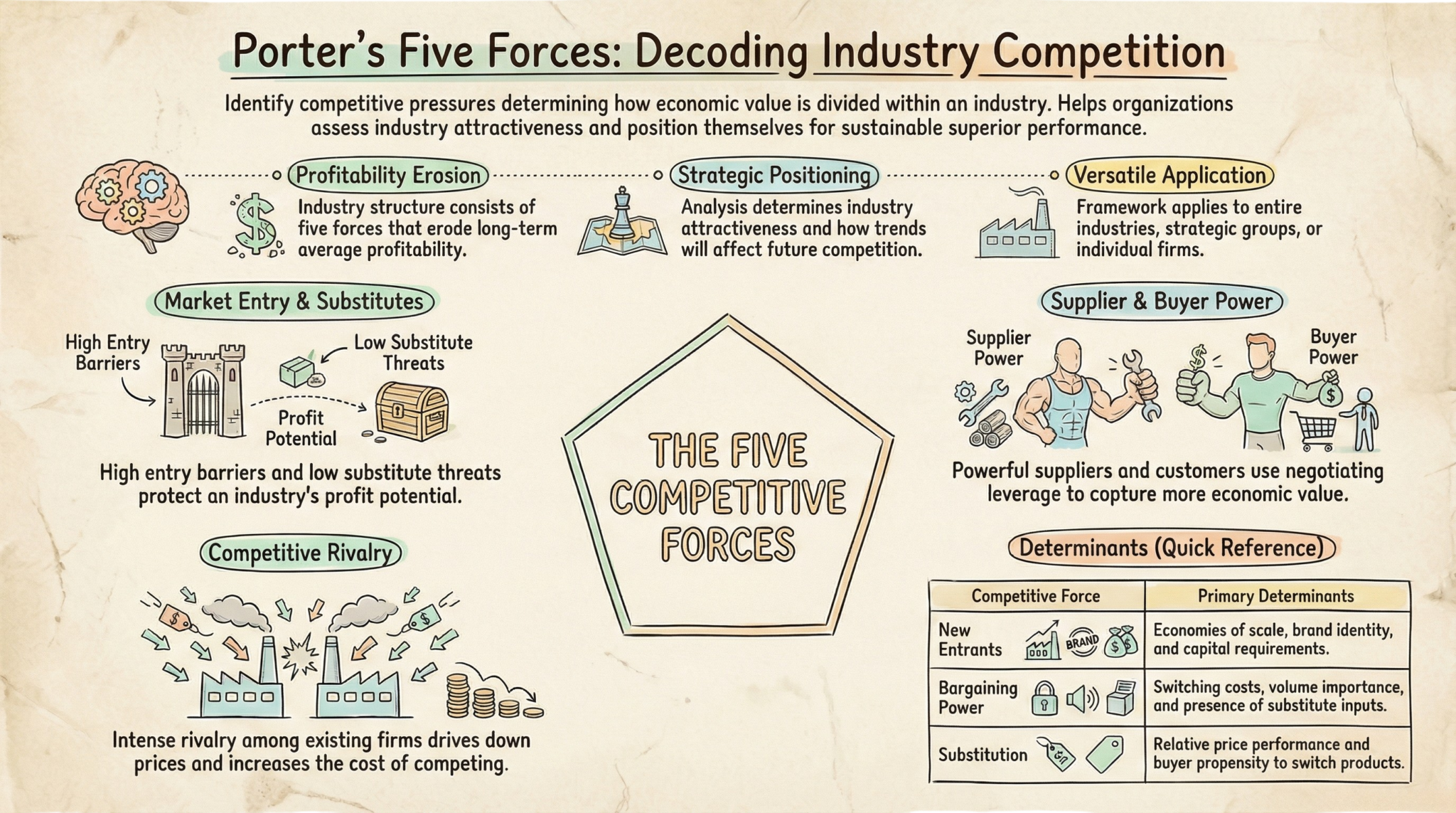
To understand what makes a market tick, business strategists turn to the “Gold Standard” of analysis: Porter’s Five Forces. Developed by Harvard Business School professor Michael E. Porter in 1979, this framework helps businesses look beyond just their direct rivals to understand the broader forces that determine profitability.
Whether you are launching a startup or analyzing a Fortune 500 company, here is how the Five Forces shape the battlefield.
1. Threat of New Entrants
The first force asks: How easy is it for a new player to crash the party?
If an industry is profitable, new companies will want to enter to get a piece of the action. This influx of fresh competition puts a cap on profit potential because incumbents must lower prices or increase spending to retain market share.
The only thing stopping them is Barriers to Entry. The higher the barriers, the more attractive the industry is for existing firms. Common barriers include:
- Economies of scale: Large companies can spread fixed costs over high volume, forcing new entrants to either come in big (risky) or accept high costs (uncompetitive).
- Switching costs: If it is expensive or annoying for customers to switch to a new entrant (like changing IT systems), they won’t do it.
- Capital requirements: Some industries, like aviation, require massive upfront investment, whereas others, like consulting, do not.
- Access to distribution: New food brands struggle if they can’t get shelf space in supermarkets.
2. Bargaining Power of Suppliers
Suppliers provide the inputs—raw materials, labor, and services—that a business needs. If suppliers are powerful, they can squeeze industry profitability by charging higher prices or limiting quality.
Suppliers tend to have the upper hand when:
- They are concentrated: If you need a specific component and only two companies on earth make it, they call the shots.
- Switching costs are high: If changing suppliers involves retraining your workforce or re-engineering your product, you are locked in.
- There are no substitutes: If there is no alternative to what they sell (e.g., a patented drug), their power skyrockets.
3. Bargaining Power of Buyers
On the flip side, your customers (buyers) want the most value for the lowest price. Powerful buyers can force prices down, demand better quality, and play competitors against each other.
Buyers are powerful when:
- They purchase in huge volumes: Think of Walmart negotiating with a small snack brand.
- Products are undifferentiated: If your product is the same as your competitor’s, the buyer will simply choose the cheaper one.
- They have low switching costs: If it costs nothing to switch from Uber to Lyft, customers will go with whoever has the lower fare at that moment.
4. Threat of Substitute Products
A substitute isn’t just a competing brand; it’s a different way to solve the same problem. For example, the substitute for an airline flight isn’t another airline—it’s a train, a car, or a Zoom call.
The threat is high if the substitute offers an attractive price-performance trade-off. If tap water becomes cleaner and tastier, it threatens the profitability of bottled soda, “shrinking the pie” for the entire soft drink industry.
5. Rivalry Among Existing Competitors
Finally, we look at the intensity of the fight between current players. High rivalry drives down profitability through price wars, advertising battles, and increased service costs.
Rivalry is usually fiercest when:
- Growth is slow: Competitors can only grow by stealing market share from each other.
- competitors are numerous or equal: If many firms have similar size and power, the battle for dominance is constant.
- Exit barriers are high: If it costs too much to leave an industry (e.g., specialized equipment that can’t be sold), failing firms stay in the market and keep prices artificially low.
Key Insight: Factors vs. Forces
A common mistake is to treat things like Government, Technology, or Growth Rates as forces. Porter argues these are actually factors that influence the five forces, rather than forces themselves.
- Government is not inherently good or bad for profits; it affects structure (e.g., patents raise barriers to entry, while unions increase supplier power).
- High Growth doesn’t guarantee profit. In fact, fast growth often attracts new entrants, increasing competition.
The Bottom Line
The Five Forces framework teaches us that “industry attractiveness” isn’t about whether a product is cool or high-tech; it’s about structure. An “unattractive” industry is one where these forces combine to drive profits down to a minimum, approaching “pure competition”.
By analyzing these forces, companies can figure out not just where to play, but how to position themselves to defend against these pressures and capture more value.