
Gold – a bubble or a recurring pattern
Gold Crash or Market Correction? An Educator’s Deep Dive into Bullion Dynamics
In the world of finance, few assets carry as much emotional and historical weight as gold. Often referred to as “the ultimate currency,” gold is a staple in discussions ranging from CA Final SCPM modules to global macroeconomic policy.
However, recent market movements have sparked a flurry of questions: Is gold heading for a crash, or are we simply seeing a textbook correction? At Fintapedu, our goal is to move past the headlines and understand the underlying economic levers that move the needle.
📖 The “Investor’s Dictionary”: Essential Definitions
To analyze the gold market effectively, we must first master the terminology. These concepts are foundational for anyone studying financial markets:
Intrinsic Value vs. Fiat Value: Gold is often perceived to have intrinsic value due to its scarcity and physical utility, whereas fiat currency (like the INR or USD) derives value from government decree and economic stability.
Real Interest Rates: This is the nominal interest rate minus the inflation rate ($Real Rate = Nominal Rate – Inflation$). Gold usually has an inverse relationship with real rates.
Safe Haven Asset: An investment expected to retain its value—or even appreciate—during periods of economic contraction or geopolitical “Black Swan” events.
Mean Reversion: The theory that asset prices and historical returns eventually return to their long-term average or mean level.
Why Does Gold “Crash”? The Economic Mechanics
A significant drop in gold prices is rarely random. It is typically the result of specific macroeconomic shifts:
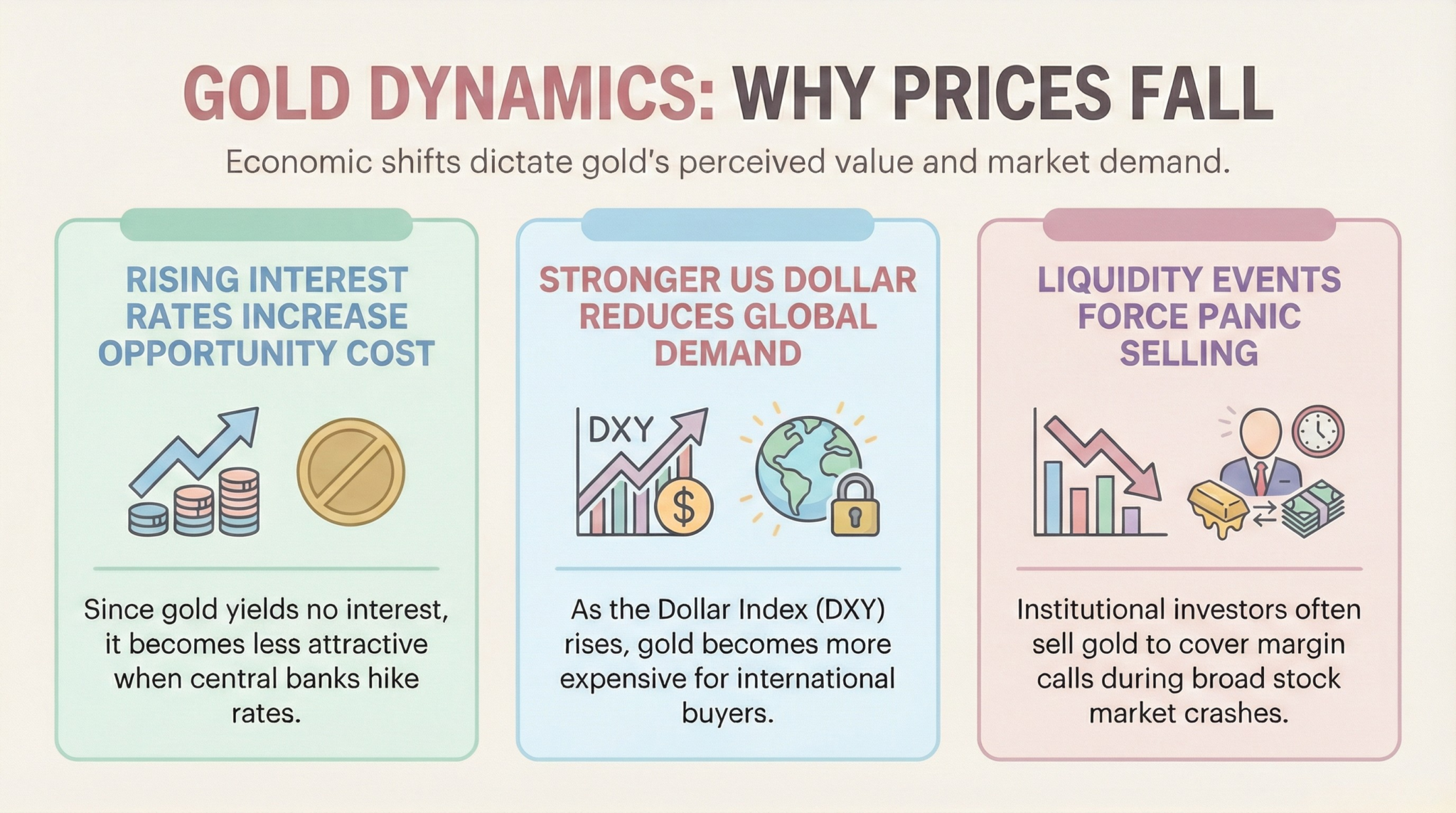
The Opportunity Cost Shift: Because gold is a non-yielding asset (it doesn’t pay interest), its “cost” is actually the interest you could have earned elsewhere. When central banks hike interest rates, the opportunity cost of holding gold rises, leading to a sell-off.
Dollar Strength (DXY): Since gold is globally denominated in US Dollars, a strengthening Dollar Index (DXY) makes gold more expensive for international buyers, reducing global demand.
Liquidity Events: During broad market panics, institutional investors may sell their “winners” (like gold) to cover “margin calls” on their losing positions in the stock market. Paradoxically, this can cause gold to drop right when you’d expect it to rise.
📝 Notes: The Analysis Perspective
When studying these patterns, it is important to look beyond the immediate price action. Here are a few “Courtesy Notes” to keep your analysis grounded:
💡 Note 01: Avoid the “Recency Bias”
Students of finance often fall into the trap of believing current trends will continue indefinitely. Historically, gold has undergone multi-year “sideways” movements. Always analyze data over a 10-20 year horizon to get the full picture.
💡 Note 02: Correlation is Not Causation
While gold often moves opposite to the US Dollar, this is not a law of physics. There are rare periods where both can rise simultaneously, usually during extreme global systemic risk. Always look for the outlier data.
The Educational Takeaway
Whether you are preparing for professional exams or simply building your financial literacy, understanding gold is about understanding global sentiment. A “crash” in gold isn’t just a number on a screen; it’s a signal that the market’s perception of risk, inflation, and currency stability is shifting.
At Fintapedu, we believe that the best investment you can make is in your own education. By understanding these mechanics, you transition from a spectator to an analyst.
Deepen Your Understanding:
Explore our full library of resources on Strategic Cost Management and Financial Markets at Fintapedu.com. We simplify the complex, so you can master the material.
About the Author