
For generations, professional students have studied in silos. You mastered Financial Reporting (FR) to please the accounting standards purists, tackled Indirect Taxes (IDT) to navigate the legal labyrinth of GST, and studied Strategic Cost Management & Performance Evaluation (SCPM/SCMPE) to think like a corporate strategist.
Then came the Integrated Business Solutions (IBS) paper, shattering those silos entirely.
In the IBS landscape, a single case study doesn’t care about subject boundaries. A strategic decision made in a boardroom ripples instantly into your financial statements and triggers immediate tax obligations. To ace this paper, you need a multi-disciplinary lens.
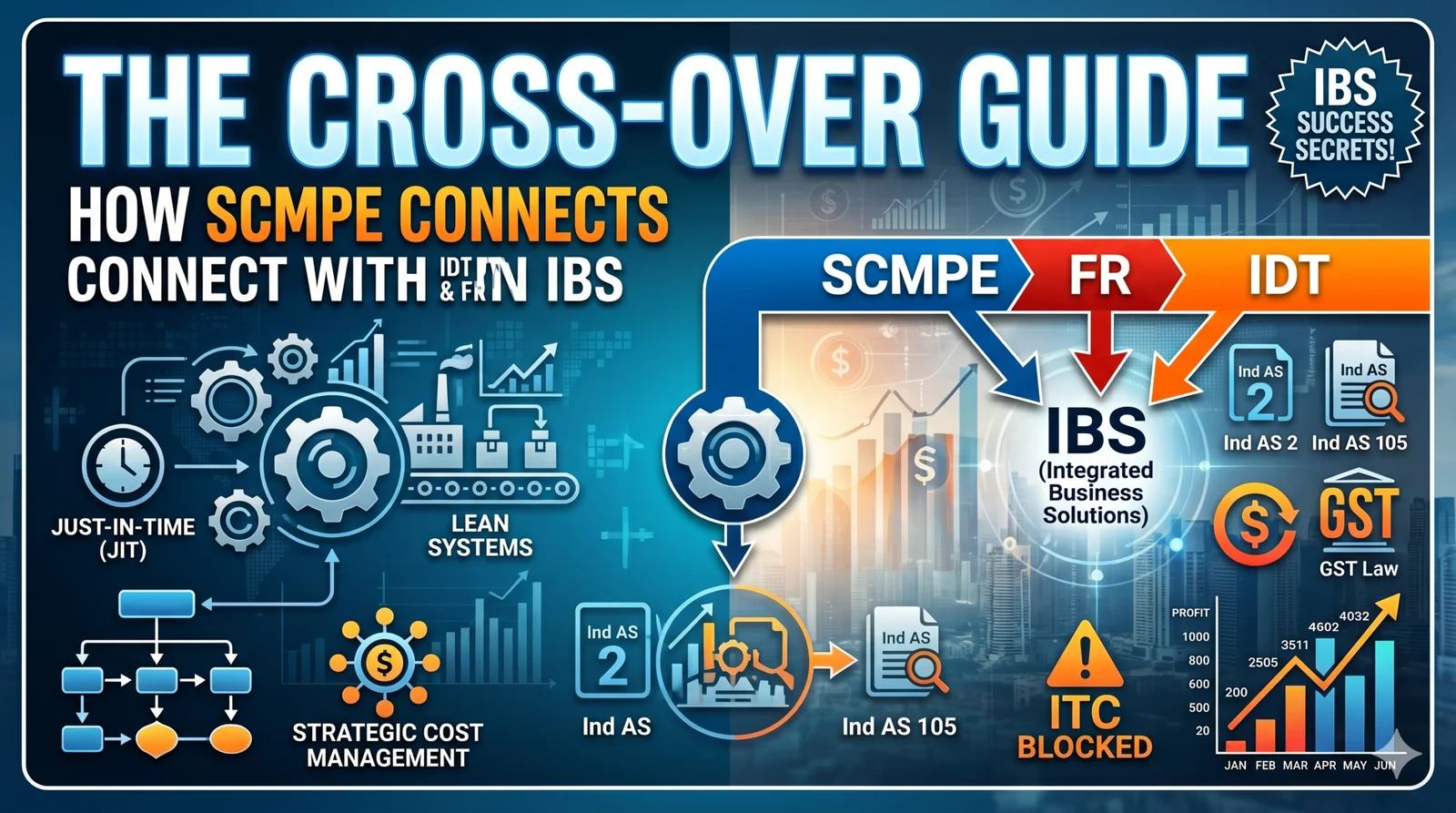
Let’s dismantle the silos and look at exactly how core SCMPE strategic frameworks directly intersect with your FR and IDT strategies.
The Strategic Triad: SCMPE → FR → IDT
When analyzing an IBS case study, train your mind to look at business scenarios through a three-step domino effect:
- The SCMPE Trigger: What strategic or operational model is the company implementing?
- The FR Impact: How does this model change our assets, liabilities, revenue recognition, or inventory valuation?
- The IDT Implication: What are the supply dynamics, GST liabilities, or Input Tax Credit (ITC) blocks triggered by this move?
Let’s explore this cross-over using two highly testable corporate scenarios.
Scenario 1: Transitioning to a Just-In-Time (JIT) Production System
Imagine a manufacturing company in your case study struggling with high holding costs and inventory obsolescence. They decide to adopt a Just-In-Time (JIT) management philosophy.
1. The SCMPE Lens (The Strategy)
JIT aims to minimize waste and eliminate storage costs by receiving goods only as they are needed in the production process. Backflush costing is often introduced here to simplify accounting, eliminating traditional work-in-progress (WIP) tracking.
2. The FR Cross-Over (The Accounting)
- Ind AS 2 (Inventories): As inventory levels plummet to near zero, the carrying cost on the balance sheet drops drastically. However, you must evaluate how Standard Costing variance adjustments or Backflush Costing entries affect the final valuation of any residual year-end inventory.
- Ind AS 37 (Provisions & Contingencies): Relying on a single supplier for JIT introduces massive operational risk. If a supplier fails to deliver, causing a breach of contract with an end customer, you must evaluate whether a Liquidated Damages Provision or an Onerous Contract liability needs to be recognized.
3. The IDT Cross-Over (The Tax)
- Section 16 of CGST Act (Eligibility for ITC): Under GST, a taxpayer can only claim Input Tax Credit upon the actual receipt of goods. In a JIT system involving continuous or split-consignment supplies, when exactly can you book the ITC?
- Section 17(5)(h) (Blocked Credit): JIT requires strict quality control. If raw materials fail quality checks upon arrival and are written off or destroyed, Section 17(5)(h) triggers an absolute block on ITC. You must reverse any credit taken on those destroyed goods—a classic point where SCMPE operational waste meets an IDT tax penalty.
Scenario 2: Modernizing Supply Chains via Lean Systems & Asset Disposal
A company wants to optimize its value chain (Value Chain Analysis) and decides to close down an inefficient, manually operated warehouse to outsource its logistics to a third-party provider (3PL).
1. The SCMPE Lens (The Strategy)
This is an execution of Cellular Manufacturing or Lean Operations to eliminate non-value-added activities. The old machinery and warehouse racking systems are scrapped or sold off to free up capital.
2. The FR Cross-Over (The Accounting)
- Ind AS 105 (Non-current Assets Held for Sale and Discontinued Operations): The moment management commits to a plan to sell these warehouse assets, you must stop depreciating them and remeasure them at the lower of their carrying amount and fair value less costs to sell.
- Ind AS 16 (Property, Plant, and Equipment) & Ind AS 36 (Impairment): If the assets cannot be sold easily, they must be tested for a sudden drop in recoverable value, leading to an impairment loss recognized in the Profit & Loss statement.
3. The IDT Cross-Over (The Tax)
- Section 18(6) of CGST Act (Supply of Capital Goods): When selling old capital goods on which ITC was previously availed, you cannot simply pay GST on the transaction value blindly. You must pay an amount equal to the ITC taken reduced by 5% per quarter or the tax on the transaction value, whichever is higher.
- Schedule I of CGST Act (Supply without Consideration): What if the company scraps the machinery by giving it away to a related party or a group company for free? Under Schedule I, it is still treated as a deemed “supply,” and GST must be paid based on open market value.
The IBS Matrix: A Quick Checklist for Case Analysis
When reading your next mock or past-year case study, keep this mental matrix handy to spot multi-disciplinary connection points instantly:
| SCMPE Framework / Event | FR Indicator (Ind AS) | IDT / GST Trigger Point |
|---|---|---|
| Total Quality Management (TQM) 🛠️ Scrapping defective output | Ind AS 2: Normal vs. Abnormal waste classification in costing. | Sec 17(5)(h): Compulsory reversal of ITC on written-off/destroyed goods. |
| Customer Profitability Analysis 🤝 Offering volume discounts to retain VIP clients | Ind AS 115: Variable Consideration. Revenue must be net of expected volume rebates. | Sec 15(3): Post-supply discounts are excluded from value only if linked to an agreement agreement and ITC is reversed by the recipient. |
| Outsourcing vs. In-house (Make or Buy) 🏭 Moving from internal production to a contract manufacturer | Ind AS 116: Check if the contract manufacturer’s dedicated facility constitutes a Lease. | Job Work Procedure (Sec 143): Tracking movement of inputs without payment of tax under Job Work challans. |
Export to Sheets
Conclusion: Developing the “Holistic Executive” Mindset
The examiners are no longer checking if you can calculate a variance or memorize a tax section in isolation. They want to see if you can think like a Chief Financial Officer (CFO).
When a company alters its strategy (SCMPE), the numbers change (FR), and the sovereign takes its share (IDT). The next time you open a case study, don’t look at it as an accounting problem or a tax problem. Look at it as a cohesive business story—and use this cross-over strategy to decode it effortlessly.
About the Author


Hi, this is a comment.
To get started with moderating, editing, and deleting comments, please visit the Comments screen in the dashboard.
Commenter avatars come from Gravatar.